Thursday, April 19, 2012

Introduction

We only have one Earth to share with 7 billion human beings. On this blue planet are 7 very different continents, with its own landscape, people, and history. One continent in particular is facing problems that no persons should ever encounter at this time and age. In Africa, one of the simplest necessities of obtaining water is a huge problem. Africans all over the continent have to walk long distances and go through painful ordeals to get water for themselves, their family, and their village. And the worse part is that this can be a daily occurrence for most people.

Our team set out to find a solution to a problem which has lasted hundreds of years. On the blog, you will see our research, and the solution to the water problem in Africa...

Solution Graphics

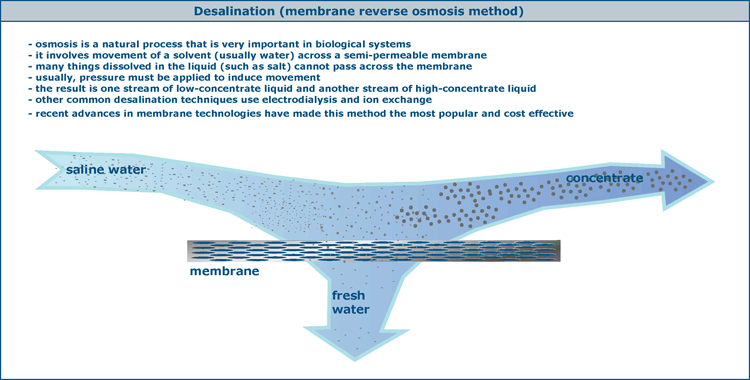
This picture shows a simplified desalination process. The saline, or salt, water comes from the oceans surrounding Africa and even with a simple membrane the water is able to be rationed out to the people. This process adds more water to the continent for use, and can decrease overall demand. 


This example of a desalination plant in Israel shows a huge number of possible storage of fresh water. These desalination plants are hugely productive and efficient and would help a continent like Africa immensely.

Solution Document

The Solution
Desalination is the removal of salt from ocean water to make it drinkable. There are several methods for effective desalination. Solar evaporation separates the salt from the sea water and has been used by sailors for at least several thousand years. 
The most common method of desalination is distillation. Most of the world’s 1,500 desalination plants use distillation, but many also use flash evaporation or electrodialysis. All of these desalination methods are very expensive, so desalination has been used very sparingly where other alternatives are also very expensive, like in desert cities. 
However, desalination research has been growing over the years due to a demand for portable water. New processes have been developed. A method involving the heating of sea water and pushing it through semi-permeable membranes to separate the salt from the water has been developed. This process can be even less expensive if the plant is near an electrical power plant that is already heating sea water for cooling functions. This method involving a semi-permeable membrane is more expensive than the others but has become more competitive and could become a solution to the scarcity of clean fresh water in Africa.
Adding Desalination plants across Africa would help the continent in so many ways. When supply finally meets demand, and accessibility is more easy and less challenging. Desalination plants can store huge amounts of fresh water, while still converting even more. If an African has easy access to water and it is there for them and clean, then they will have a greater day. And with these plants will come organization and methods of storage and probable ways of transportation. Desalination plants are a true solution to the water problem in Africa.

Graphic of Causes

In the image above, you can see all the different causes of the water scarcity. All of these factors created an economic and practical access to clean, fresh water.

Causes of the Water Scarcity in Africa


The Water problem in Africa
For years Africa has been hit with great scarcity of water. More than half of all Africans lack access to fresh water, causing 5,000 children to die each day. Six major causes have been linked to this water scarcity in Africa. These major causes are no rain fall, ground water, inefficient use of resources, weak infrastructure, a troubled state, and extreme conditions.

A major cause of water scarcity in Africa is no rain fall. The Horn of Africa and Namibian Desert receives no rain fall. The entire western part of the continent receives as much 4,000 mm annually, while the rest of the continent falls in between 200-800 mm of rainfall annually. Draughts in Africa have been known to last up to 5 years.

The ground water of Africa is also a major cause. Three quarters of all Africans use ground water as their main water supply. Ground water is only 15% of the continent’s water supply. There are serious concerns about the quality of the ground water in Africa. It is extremely dirty and unhealthy, as seen in the pictures.

In this picture, a small African child drinks out of a brown lake. Dirty water is very common in Africa and is a major health problem.

There is inefficient use of resources in Africa. 4 trillion cubic meters of water are available, but only 4% is used. Most people in Africa lack technology and money to access water supplies.

As shown in the image above, Africa has a huge ecomomic water scarcity. Almost the whole continent has this problem, even areas close to the ocean or lakes. There are also physical water scarcities in desert areas and South Africa.

Weak infrastructure has also hit Africa, causing a scarcity in water. A weak infrastructure prohibits the economy from growing. Africa has 15% of the world’s population, but less than 1% of global manufacturing. 30 countries face regular power outages, according to a 2010 report by the World Bank and France’s development agency.

Another cause of the water scarcity in Africa is the troubled state that Africa is in. There have been over 9 million refugees and internally displaced people from conflicts in Africa. Hundreds and thousands of people have been slaughtered from a number of conflicts and civil wars.

The last major cause of the water scarcity in Africa is the extreme conditions of the continent. Africa is the hottest continent of earth. Drylands and deserts make up 60% of the entire land surface. The record for the highest temperature recorded was set in Libya in 1922 at 136 degrees Fahrenheit.

Africa is infamous in the fact that it has a high poverty rate and the people who live there have to work long and hard to get the basic essentials to live. The picture shows a group of women in Africa each carrying a case of water they had to get themselves. Sometimes women have to walk miles to gather water each day for their family or village.

The Water Problem in Africa: Research document

Water Scarcity in Africa

  • 5,000 children die each day in Africa due to dehydration
  • Approximately one child dies every 17 seconds
  • Of all the renewable water in Africa, only 4% is used each year
  • More than half of Africans lack access to fresh water
  • An American taking a five-minute shower uses more water than the typical person living in a developing country’s slum uses in a whole day.
  • 1 billion people in the world do not have access to safe water. This is roughly one in eight of the world’s population. In Africa, two out of five people lack clean water.
  • The average North American uses 158.5 gallons of water a day. The average person in the developing world uses 2.6 – 5.2 gallons a day for drinking, washing and cooking.
  • The average weight of water women in Africa carry on their heads is 50 pounds, the same as the average airport checked luggage allowance.
  • Every year there are 4 billion cases of diarrhea as a direct result of drinking contaminated water – resulting in 2.2 million deaths each year. This is equivalent to 20 jumbo jets crashing every day.
  • 98 percent of water-related deaths occur in the developing world
  • 1.4 million children die every year from diarrhea caused by unclean water and poor sanitation. That’s 4,000 child deaths a day or one child every 20 seconds.
  • About 2 in 3 people lacking access to clean water survive on less than $2 per day, with 1 in 3 living on less than $1.
  • The water and sanitation crisis claims more lives through disease than any war claims through guns.
  • 84 percent of water related deaths are in children ages 0-14.
  • 90 percent of wastewater in developing countries is discharged into rivers and streams without any treatment.
  • There are 1.6 million deaths per year attributed to dirty water and poor sanitation
  • In the past ten years, diarrhea related to unsanitary water has killed more children than all the people lost to armed conflict since WWII.
  • At any one time, it is estimated that half the world's hospital beds are occupied with patients suffering from waterborne diseases.
  • The average distance that women in developing countries walk to collect water per day is four miles and the average weight that women carry on their heads is approximately 44 pounds.
  • Over 40 billion work hours are lost each year in Africa to the need to fetch drinking water.

Issue 3: Overfishing

Overfishing

· Catching too much fish degrades system

· Non-sustainable use of oceans

  • · Fishing fleets 2-3 times larger than needed
  • · 80% of fisheries are fully-to-over-depleted
  • · ecology of oceans under stress
  • · risk of losing food source
  • · marine mammals, sharks, sea birds, noncommercial fish affected

Solutions

  • · safe catch limits
  • · controls of bycatch
  • · protection of pristine and importany habitats
  • · monitoring and enforcement

Issue 2: Water Problem in Africa

The Water Problem in Africa
  • 5,000 children die each day in Africa due to dehydration
  • Approximately one child dies every 17 seconds
  • Of all the renewable water in Africa, only 4% is used each year
  • More than half of Africans lack access to fresh water
  • 90 percent of wastewater in developing countries is discharged into rivers and streams without any treatment.
  • There are 1.6 million deaths per year attributed to dirty water and poor sanitation
  • In the past ten years, diarrhea related to unsanitary water has killed more children than all the people lost to armed conflict since WWII.
  • At any one time, it is estimated that half the world's hospital beds are occupied with patients suffering from waterborne diseases.
  • The average distance that women in developing countries walk to collect water per day is four miles and the average weight that women carry on their heads is approximately 44 pounds.
  • Over 40 billion work hours are lost each year in Africa to the need to fetch drinking water.

Issue 1: Harmful Waste

Harmful Waste

Waste is a byproduct of chemical, industrial, and mechanical processes at places such as factories, power plants, and restaurants. There is both hazardous waste, and non-hazardous waste, but both are a problem to the marine ecosystem.

  • - Consumer consumption has gone up more and more each year.
  • - More products = more waste; it’s an increasing problem
  • - Attracts insects, rodents, scavengers, sickness, etc.
  • - Damages ecosystems/food chains/etc
  • - A lot of waste is dumped into the ocean and is very hurtful to the species and flora that live there.
  • - Waste does not “go away”; Some products can take years to dissolve

- Hazardous waste: waste that is dangerous or potentially harmful to our health or the environment

  • - Hazardous waste also includes chemicals, nuclear waste, and other potentially life-threatening pollutants.

- Non-Hazardous waste: solid waste (garbage or refuse, sludge from a wastewater treatment plant, water supply treatment plant, or air pollution control facility, and discarded material)

  • - Lots of plans to ‘minimize’ dumping, but no definite plan.